
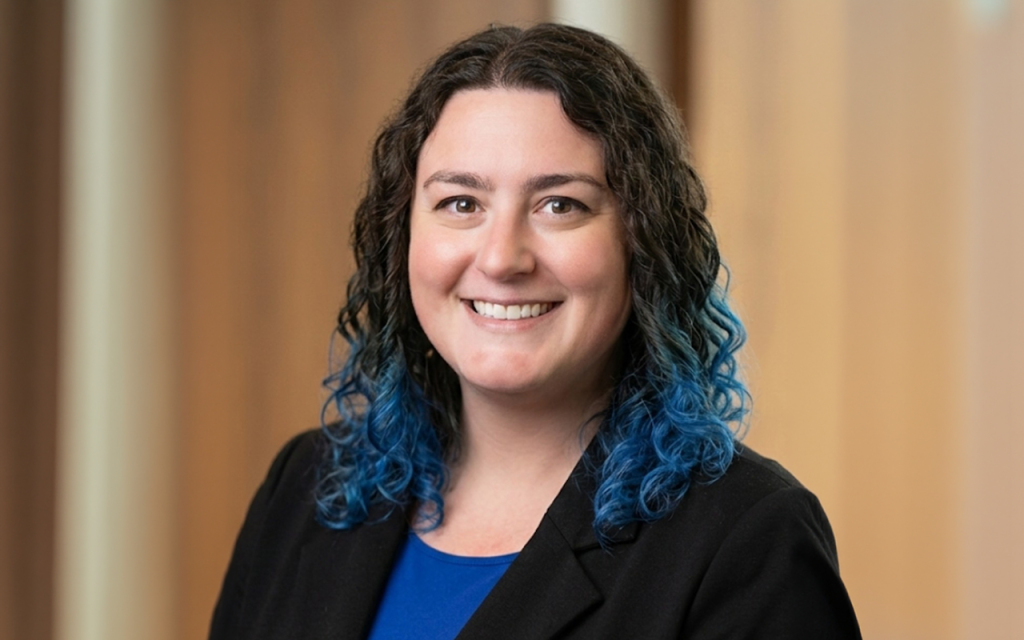



LEXINGTON, Ky. – Throughout National Social Work Month and National Criminal Justice Month this March, the University of Kentucky College of Social Work (CoSW) will be sharing stories on the humans of the CoSW, highlighting the critical role our people play in supporting individuals, families and communities across Kentucky and beyond.
For CoSW alumna Jiselle Hirsch, a career in social work was a deeply personal choice. As a former foster youth, Hirsch was in and out of the system throughout her childhood, becoming a single mother at the age of 19.
Living at One Parent Scholar House in Lexington, Hirsch received affordable housing as she pursued her education. Receiving that support as she raised her child and went back to school inspired her to be a changemaker in her community, helping people with backgrounds like hers.
“I was receiving a lot of benefits and services myself, and I could see how, with the right supports, people can really turn their lives around,” Hirsch shared. “I wanted to be a part of that process.”
Beginning her education at Bluegrass Community Technical College (BCTC), Hirsch transferred to UK’s Bachelor of Social Work (BASW) program after receiving the Public Child Welfare Certification Program (PCWCP, now known as Child Welfare PREP) scholarship. For Hirsch, the scholarship represented both opportunity and validation.
“Earning the PCWCP scholarship made me feel worthwhile,” Hirsch said. “Growing up in the situation that I did, there were a lot of times when I didn’t feel like I had value to contribute. This scholarship made me feel like the work I was doing was valuable.”
Pursuing social work as a former foster youth gave Hirsch insight into the children and families she would one day be working with. The level of empathy gained from her experiences allowed her to understand issues within the system that others might not have insight into.
Breaking her own cycle of trauma was a motivating factor in Hirsch’s career in social work. She graduated with her BASW in 2013 and has been making a difference for children and families ever since.
“That’s where I work from now — trying to break the cycle within families to prevent future maltreatment,” Hirsch said. “Especially with my child, I wanted them to see that if I could be successful, they could be successful as well.”
Following graduation, Hirsch worked in Scott County for the Department for Community Based Services for three years. After relocating to North Carolina, Hirsch worked in investigations, as well as with LINKS, a foster care initiative supporting youth aged 13–21 in transitioning to adulthood through vocational training, education, housing assistance, and life skills development.
Over time, Hirsch realized that lasting change requires not only direct support for families, but stronger systems designed to intervene early and effectively. Continuing her career in child welfare, Hirsch now works as a Regional Child Welfare Prevention Specialist for the North Carolina Department of Health and Human Services. She serves as the Policy and Communication Lead for Prevention Services.
In her current role, Hirsch works to strengthen prevention services and uplift families across North Carolina, the kind of support that once helped change her own trajectory.
“I’m very proud of myself,” Hirsch said. “Not everybody has the support they need to break the cycle, and I’m very grateful for the support I received. Without it, I would not be where I am. That’s why I try very hard to be a support to others whenever I can and to give grace whenever I can.”
As the College of Social Work highlights the humans at the heart of social work and criminal justice this March, Hirsch’s story serves as a reminder of the transformative power of support, opportunity and compassion.